Sydney’s housing market has fallen 5.1% from its peak, according to NAB. To undo the past three years, it would need to fall nearly four times that.
The current downturn, while real, is still shallow set against what the past three years of growth built. For sellers weighing whether to list now or wait, and for buyers wondering how much further prices might slide, it’s that context that’s important, not just the news of the slowdown.
How far have Sydney house prices fallen?
A July 2026 report from Domain examined eight completed housing downturns since the mid-1990s with the average decline being just 2.9%. Even the sharpest on record, in 2016-19, saw prices fall 8.5% nationally and 14% in Sydney before recovering fully. Prices have never fallen far enough to erase a full growth cycle, and the current one is proving no exception so far.
What’s causing the current Sydney property downturn?
Previous slowdowns were typically driven by tighter lending standards or a single shock event. This one is being driven by a combination of higher interest rates, global economic uncertainty and a decline in investor activity following the recent federal changes to negative gearing and capital gains tax – a slower, more grinding correction rather than a sharp one.
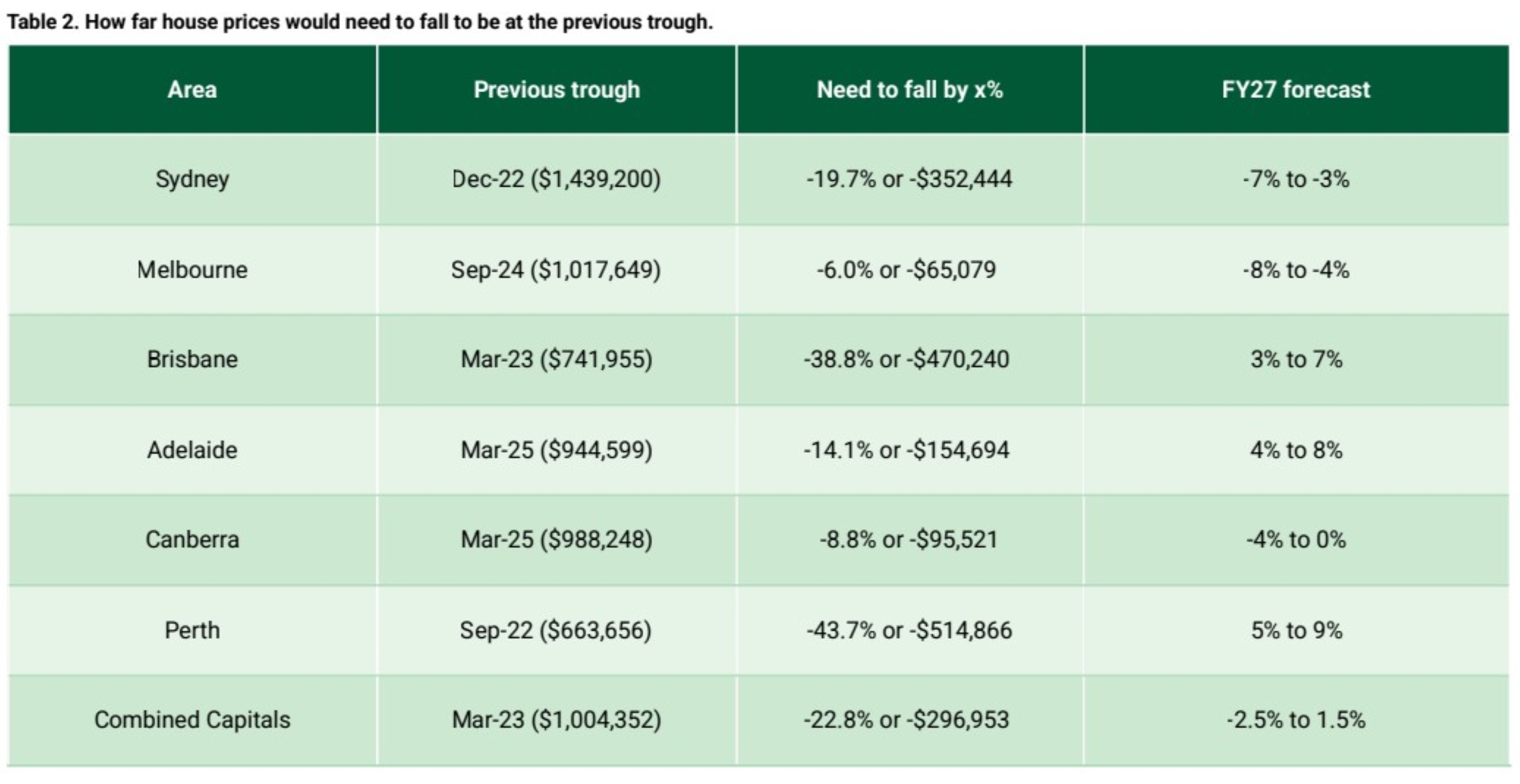
NAB has revised its Sydney forecast to reflect this, now expecting a peak-to-trough decline of around 10%, roughly double its earlier estimate for the combined capitals. Domain’s forecast is more conservative, at 3 to 7% over the year ahead.
Either way, both sit well short of the 19.7% that would be required to return Sydney’s median to its December 2022 trough.
Should I sell my house on the Lower North Shore now?
For owners here, the lesson is to separate the headline from the reality on the ground. Reading “Sydney prices to fall 10%” might concern you, but scarcity of stock in established suburbs such as Mosman, Neutral Bay and Cremorne typically cushion these areas more than the broader market.
When will interest rates drop in Australia?
For buyers, the figure to watch is not the depth of the fall but the turning of the rate cycle. All four major banks now expect the RBA to hold the cash rate at 4.35% through the rest of 2026, with the first cut tipped for 2027. In every one of the past eight cycles, it was that shift, not the size of the preceding downturn, that signalled the start of the next recovery.
In short, Sydney’s housing market is correcting, but the data suggests it has a long way to go before it undoes what the past three years built. On the Lower North Shore, scarcity and quality have historically kept the market here solid.
The team at Richardson & Wrench Mosman/Neutral Bay is happy to talk through what this means for your property. Call (02) 9969 7622 or email info@rwm.com.au.